The quick answer
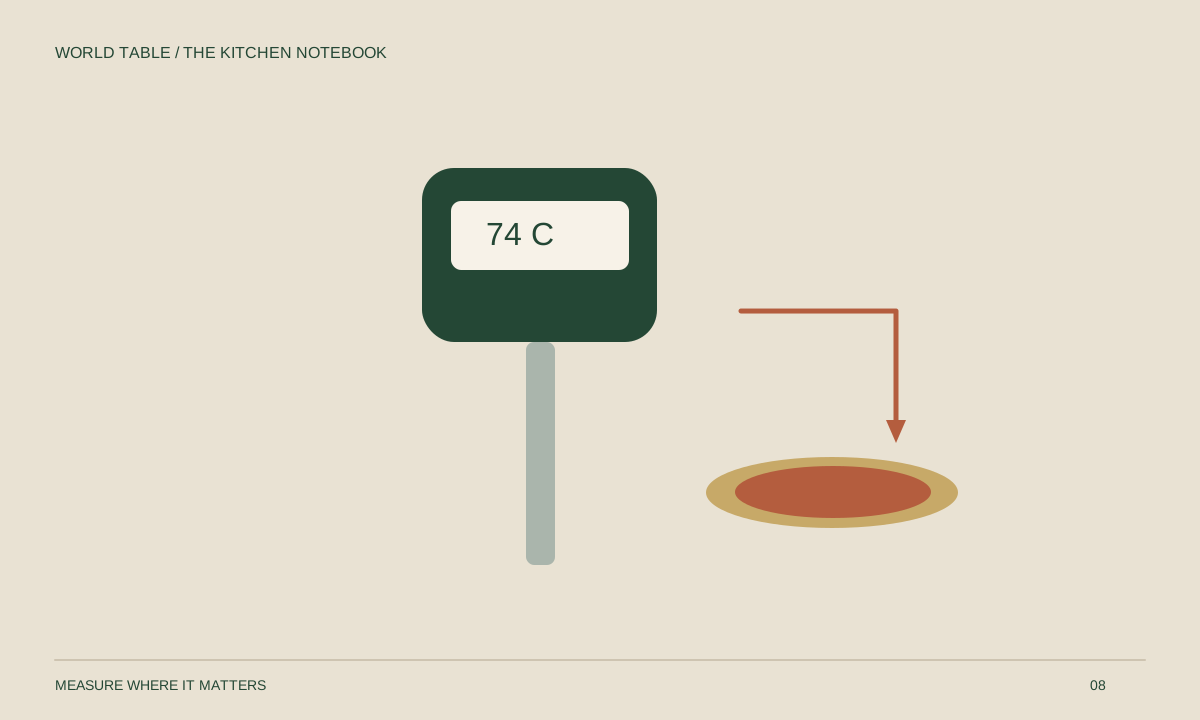
Insert a suitable food thermometer into the center of the thickest part, away from bone and the pan. For thin pieces, insert sideways. Wait for a stable reading and check more than one spot. Use the temperature and any required rest time together.
In this guide
Choose the right type for the job
An instant-read thermometer checks food near the end of cooking; it normally should not stay in the oven. A leave-in probe must be rated for the cooking temperature and environment. Keep cables away from direct flame and follow the sensor-depth instructions for your model.
A surface infrared thermometer cannot tell you the temperature inside chicken or a burger. A fast display is useful, but correct placement still matters. Clean the probe before and after use and between raw-food checks and ready-to-eat food.
Find the coldest useful measurement
Aim for the center
Insert into the thickest part without touching bone, a large pocket of fat, the tray or the pan. Ensure the sensing area is within the food.
Go sideways for thin food
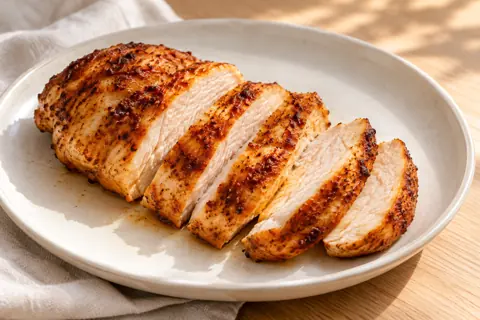
For a thin chicken breast, chop or burger, approach from the side so the sensor can reach the middle rather than passing through it.
Wait and compare
Let the reading stabilize according to the thermometer’s response time. Check several places and pieces, especially in an uneven batch. Use the lowest relevant reading to judge whether more cooking is needed.
Keep equipment clean
Wash or sanitize the probe as the maker directs after contact with undercooked food. Use a clean plate and clean utensils for the finished meal.
Common minimum internal temperatures
The following values follow U.S. household food-safety guidance for these foods. Apply any stricter local guidance or recipe requirement. A browned exterior or clear juices do not replace a temperature check.
| Food | Minimum internal temperature | Rest requirement |
|---|---|---|
| Chicken, turkey and other poultry | 165°F / 74°C | No additional safety rest specified. |
| Ground beef, pork, lamb or veal | 160°F / 71°C | No additional safety rest specified. |
| Whole beef, pork, lamb and veal steaks, chops and roasts | 145°F / 63°C | At least 3 minutes. |
| Fish | 145°F / 63°C | No additional safety rest specified. |
| Casseroles and reheated leftovers | 165°F / 74°C | Check the center and other cold spots. |
Check the thermometer, not only the meat
If readings seem implausible, review insertion depth, battery state and the maker’s accuracy specification. Some models allow an ice-water check and calibration; others can only be checked or serviced. Follow the manual and do not adjust a non-adjustable device by guesswork.
For an ice-water check permitted by the manual, use a well-stirred mixture of crushed ice and water, keep the sensor off the cup and allow it to stabilize. Ice water should be near 32°F / 0°C. Boiling-water checks need adjustment for altitude and are not interchangeable with this procedure.
Doneness, safety and resting are different decisions
Meat may rise in temperature after leaving the heat, but the amount varies with thickness and cooking conditions. Do not count on an assumed carryover increase to meet a minimum. When a minimum includes a rest, start that rest after the food has reached the required temperature. Resting for juiciness can be useful even when no safety rest is specified.
A few useful answers
Can I use color to tell when a burger is safe?
Color is not a reliable substitute for checking its internal temperature.
Can an instant-read thermometer stay in the oven?
Usually not. Only leave it in if the manufacturer explicitly rates it for that use.
Care and appliance instructions vary by model. Use your product’s stated limits and the method that suits its material.
Put it into practice