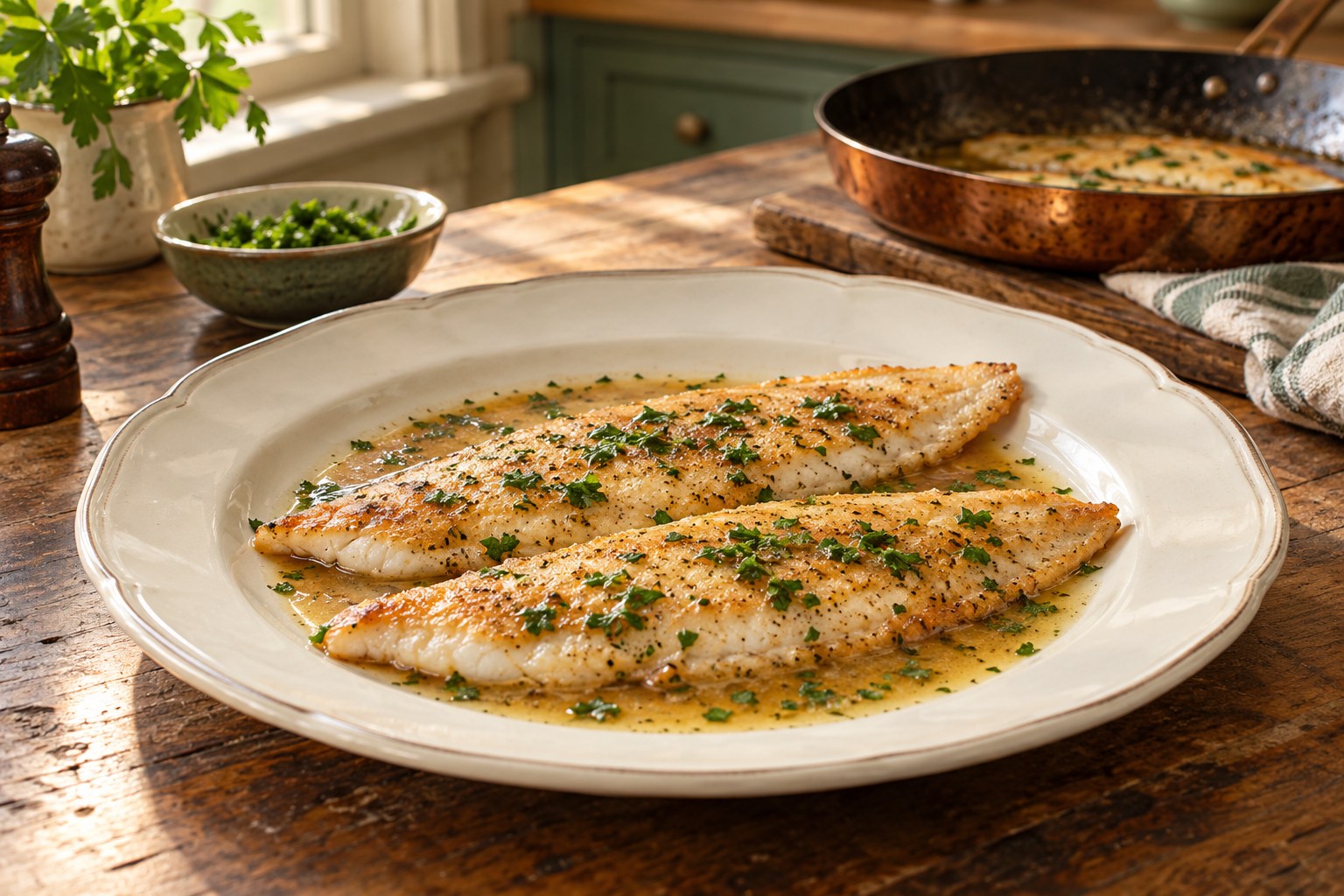
Equipment
- Large nonstick frying pan
- Fish spatula
- Plate for flour
- Tongs
- Food thermometer
- Warm oven-safe plate
Before you begin
Metric weights govern the recipes; US weights and volumes appear alongside. Weigh ingredients after peeling, trimming or boning when specified. Cooked and drained weights are different from raw weights. A teaspoon is rounded to 5 ml and a tablespoon to 15 ml. Egg weights exclude shells. Use a scale for flour, small seasonings and recipes that separate yolks and whites.
Make it work
- Plaice or lemon sole fillets of similar thickness can replace sole; use the same edible weight and check the cooking endpoint. Rice flour can replace wheat flour for coating if suitable for your needs. It changes the crust; check for cross-contact when avoiding gluten.
Prep 15 min · Cook 20 min
Allow 15 minutes to prepare and coat and up to 20 minutes to heat the pan, cook two batches and finish the sauce. The cooking butter is 30 g in total, split between batches; the separate 30 g makes the sauce. Extra batches need extra time.
Ingredients
- Fish — 600 g / 21.16 oz: Sole fillets — 8 small skinless boneless fillets
- Fish — 40 g / 1.41 oz: Plain all-purpose flour — for coating, excess discarded
- Fish — 3 g / 0.11 oz: Fine salt
- Fish — 0.3 g / 0.01 oz: Black pepper
- Fish — 30 g / 1.06 oz: Unsalted butter
- Fish — 15 ml / 1 tbsp: Neutral oil
- Lemon butter — 30 g / 1.06 oz: Unsalted butter
- Lemon butter — 30 ml / 2 tbsp: Lemon juice
- Lemon butter — 10 g / 0.35 oz: Fresh parsley — finely chopped
Step-by-step method
- Dry and coat the fillets
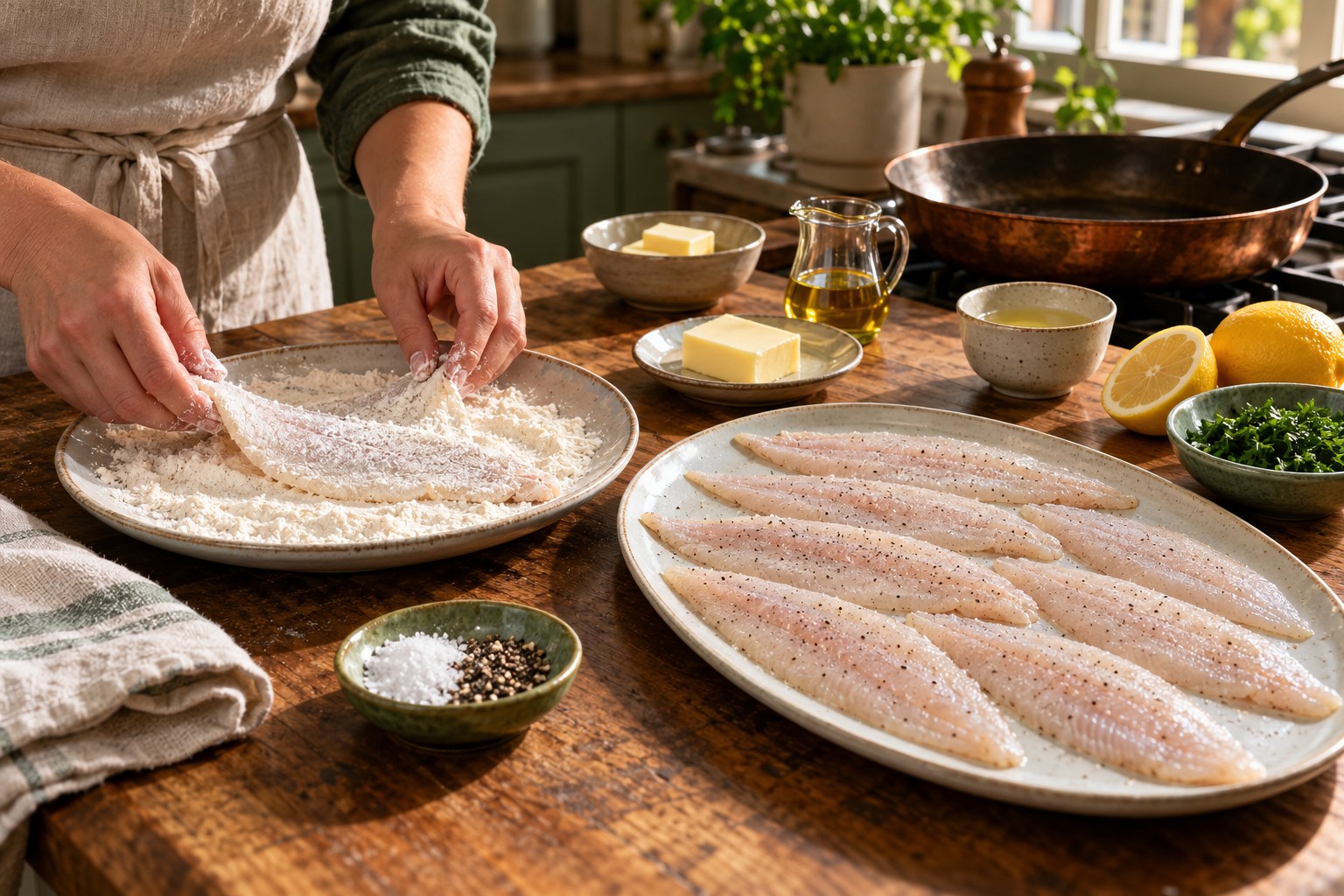
Check fillets for pin bones, pat dry and season with salt and pepper. Put flour on a plate. Dust each fillet just before cooking and shake off loose flour; a thick coating becomes pasty. Heat the oven to 80°C / 175°F for a brief hold between batches. - Cook the first batch
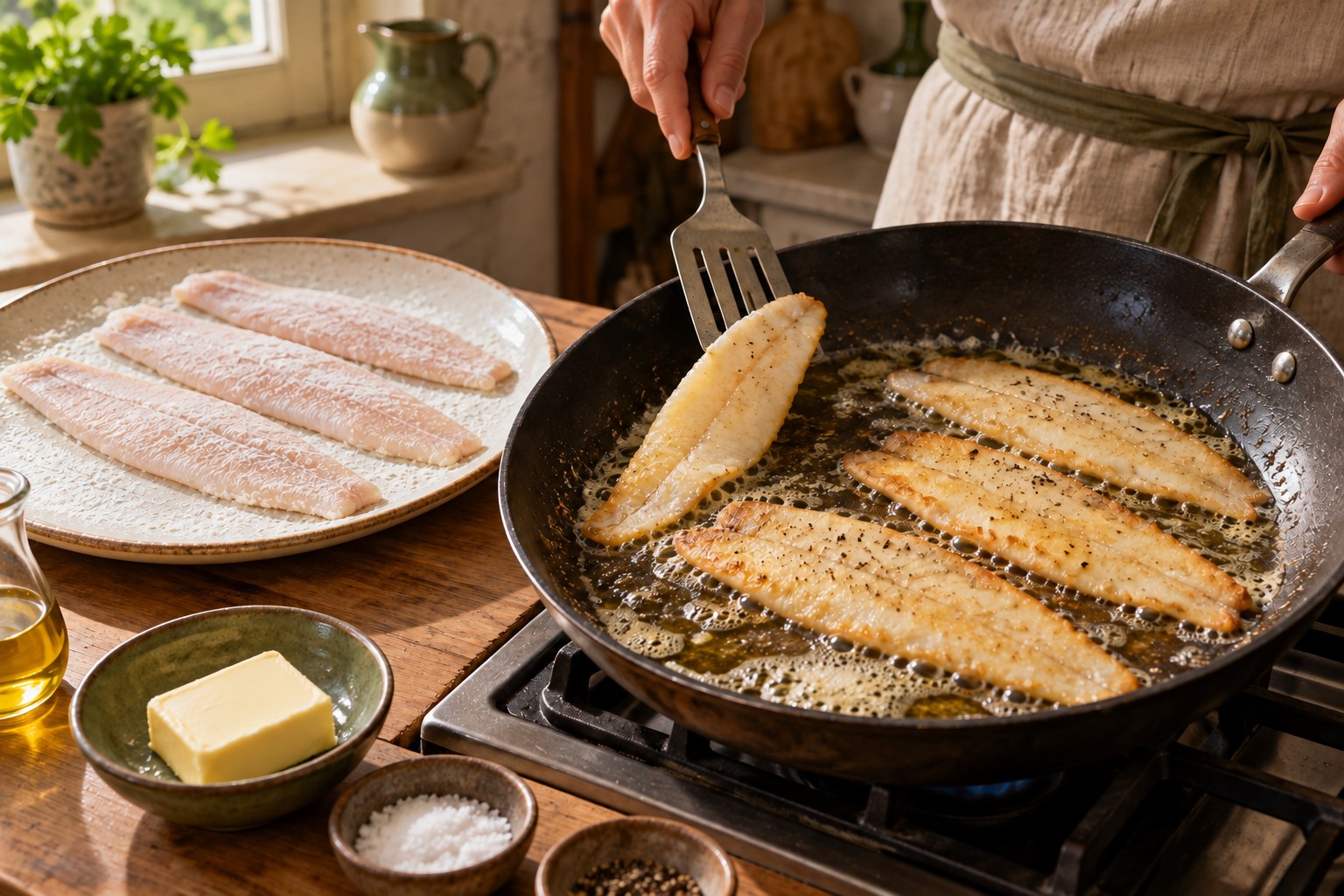
Heat half the oil and 15 g / 0.53 oz of the cooking butter in a large nonstick frying pan over medium-high heat. When butter foams, add 4 fillets without overlapping. Cook for about 2–3 minutes on the first side and 1–2 minutes on the other, until lightly golden, opaque and reaching 63°C / 145°F at the thickest part. Thin fillets may cook faster. Lift onto a warm plate and hold briefly in the oven. - Finish the second batch
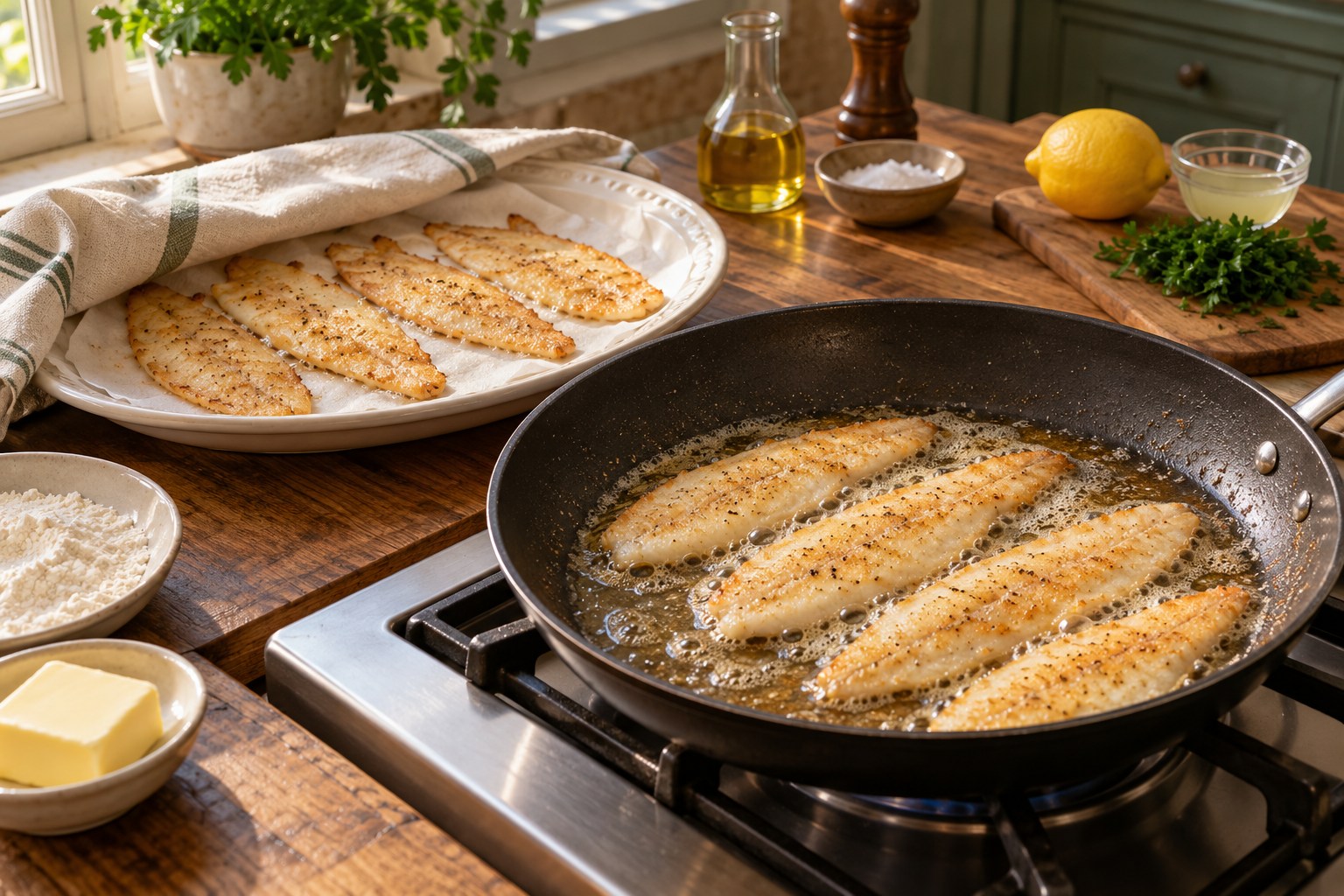
Wipe out dark flour residue carefully with kitchen paper held in tongs. Add the remaining oil and 15 g / 0.53 oz cooking butter and cook the remaining 4 fillets in the same way. Keep the cooked fish warm only while finishing the sauce; prolonged holding dries it out. - Make the lemon butter
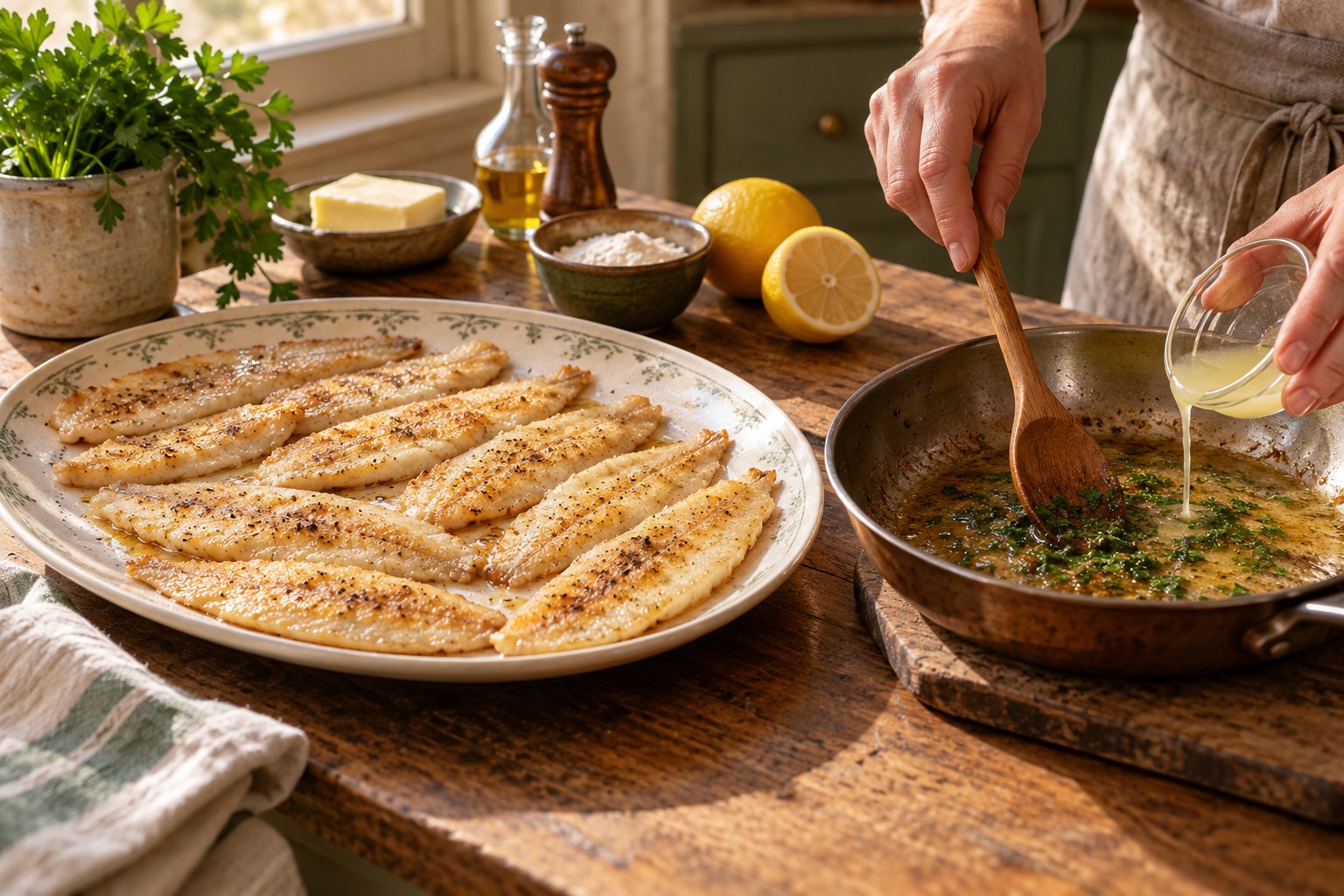
Wipe the pan and melt the separate 30 g / 1.06 oz butter over medium heat. Swirl until the milk solids turn hazelnut-gold and smell nutty, usually 1–2 minutes. Remove from the heat, wait until vigorous bubbling subsides, then carefully stir in lemon juice and parsley. Divide the 8 fillets among 4 plates and spoon the sauce over them. Serve immediately.
Cook’s notes
This fillet version is easier to portion than a whole sole meunière. The butter should smell nutty, not burnt; start the finishing butter again if the milk solids turn black. A fish spatula helps lift the fragile fillets intact.
Storage & reheating
- Best served freshly cooked. Cool leftovers promptly in shallow portions and refrigerate at 4°C / 40°F or below within 2 hours. Use within 2 days. Reheat once to 74°C / 165°F throughout; fish becomes firmer when reheated. Do not freeze the finished lemon-butter fish for the intended delicate texture.
Allergens
Fish; Wheat; Milk
Approximate nutrition
Per serving: 300 kcal · Protein 27.5 g · Carbohydrates 8.4 g · Fat 17.5 g.
Approximate values per stated portion. Ingredient brands, edible yield and absorbed frying oil affect the result.