Equipment
- Scale
- Mixing bowl
- Rolling pin
- Ruler
- Baking paper
- Covered refrigerator space for flat dough
- Sharp knife
- Two baking trays
- Pastry brush
- Racks
- Food thermometer
Before you begin
Metric weights govern the recipes; US weights and volumes appear alongside. Weigh ingredients after peeling, trimming or boning when specified. Cooked and drained weights are different from raw weights. A teaspoon is rounded to 5 ml and a tablespoon to 15 ml. Egg weights exclude shells. Use a scale for flour, small seasonings and recipes that separate yolks and whites.
Make it work
- Use an unsalted butter with suitable lamination strength if European-style butter is unavailable; very soft spreadable butter or low-fat spread is not equivalent. A dairy-free croissant needs a separately developed laminated formula. Shop-bought puff pastry is not a direct substitute for this yeasted croissant dough.
Prep 100 min · Cook 30 min · Waiting 920 min
The 1050-minute plan adds 100 minutes of active work,30 minutes of baking and 920 minutes of waiting:60-minute first rest,480-minute overnight chill,30-minute butter lock-in chill,45 and 45 minutes between turns,60 minutes after the third turn,20-minute sheet rest,150-minute final proof and 30-minute cooling. Butter-block chilling overlaps the overnight rest. Cooler proofing or extra dough-relaxing pauses extend the plan.
Ingredients
- Yeast dough — 500 g / 17.64 oz: White bread flour
- Yeast dough — 140 ml / 4.73 US fl oz: Water — cool
- Yeast dough — 140 ml / 4.73 US fl oz: Whole milk — cool
- Yeast dough — 50 g / 1.76 oz: Caster sugar
- Yeast dough — 10 g / 0.35 oz: Fine salt
- Yeast dough — 7 g / 0.25 oz: Instant yeast
- Yeast dough — 40 g / 1.41 oz: Unsalted butter — melted and cooled
- Lamination — 250 g / 8.82 oz: Unsalted butter — cold but pliable, preferably about 82% fat
- Lamination — 35 g / 1.23 oz: White bread flour — for light rolling dust, excess brushed away
- Egg wash — 50 g / 1.76 oz: Eggs — 1 large egg without shell, beaten
- Egg wash — 10 ml / 2 tsp: Whole milk
Step-by-step method
- Make the dough on day one
Mix dough flour, yeast, sugar and salt. Add cool water,140 ml / 4.73 US fl oz milk and the separate 40 g / 1.41 oz melted, cooled butter. Knead for 5–6 minutes until smooth enough to hold together, without intensive bread-style kneading. Flatten into a thick rectangle, cover and leave at cool room temperature for 60 minutes. Press out large bubbles, wrap with room to expand and refrigerate at 4°C / 40°F or below for at least 8 hours. - Make the butter block
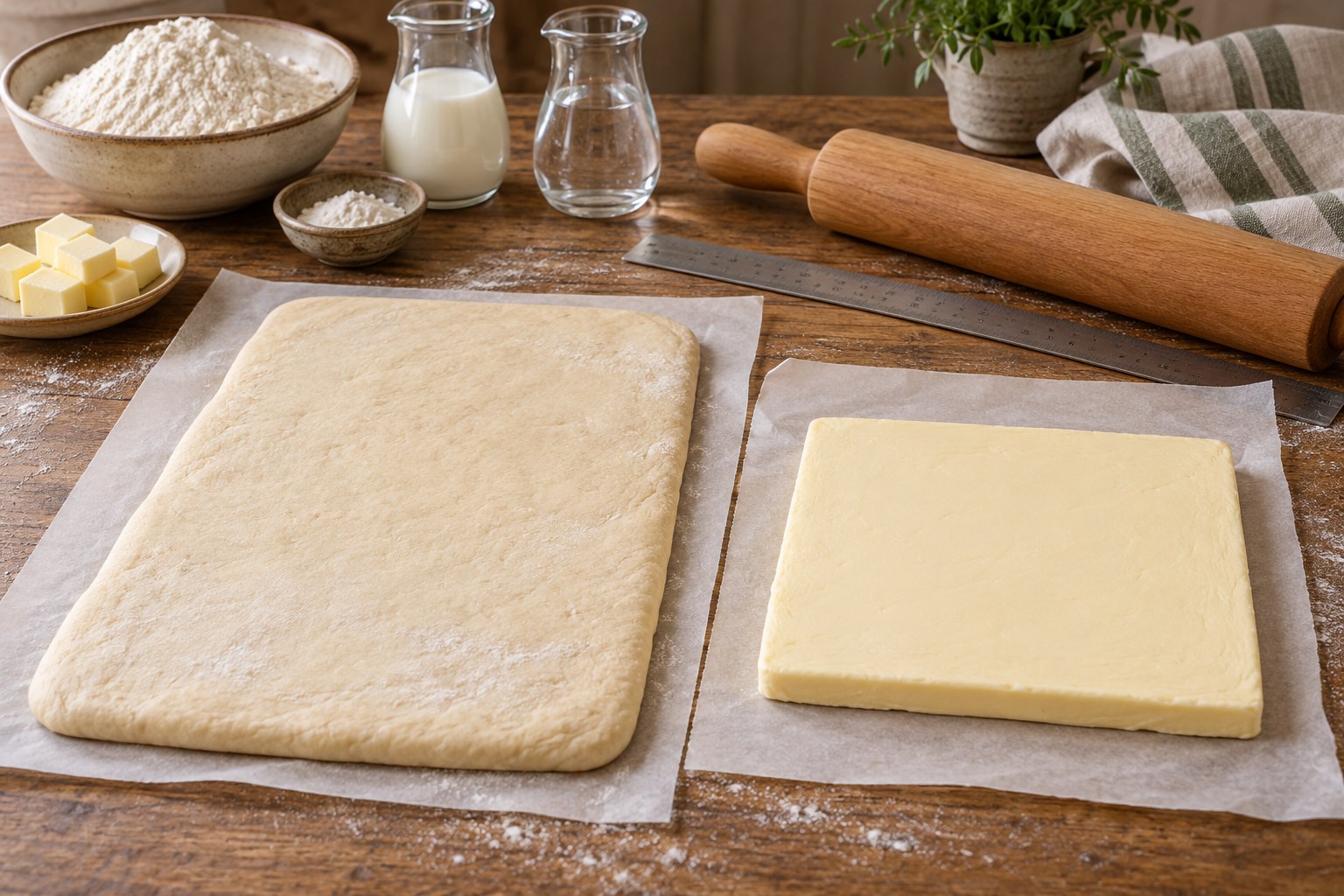
During the cold rest, put the 250 g / 8.82 oz lamination butter between sheets of baking paper and tap and roll into an even 20 ×20 cm / 8 ×8 in square. Refrigerate. Before locking it into dough, let it become flexible enough to bend slightly without cracking, while still cold. Dough and butter should feel similarly firm; greasy melted butter cannot form separate layers. - Enclose the butter
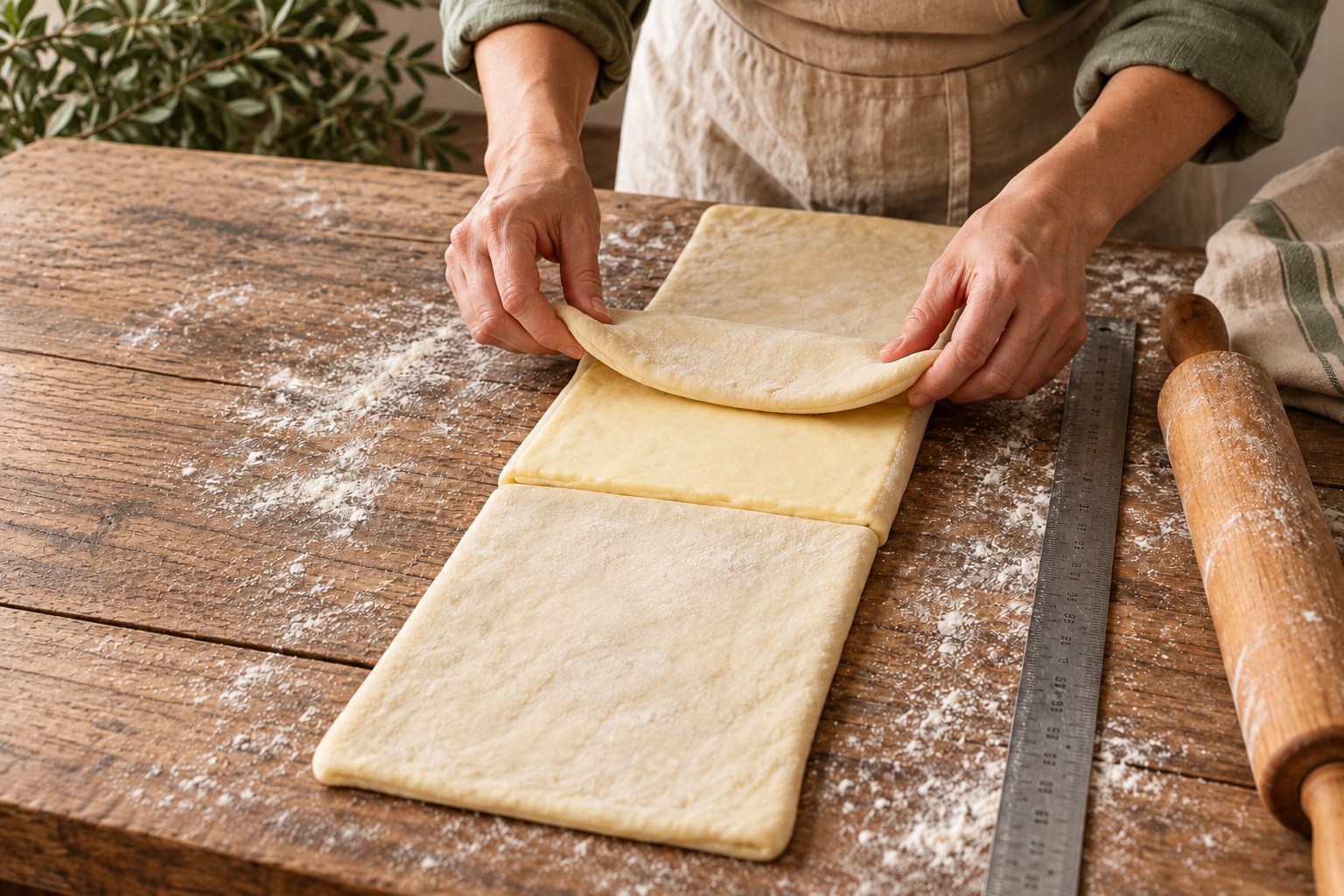
On a lightly floured surface roll cold dough to 22 × 42 cm / 9 × 16 1/2 in. Set butter over one half, leaving a narrow dough border. Fold the other half over and pinch edges closed. Brush away loose flour and wrap. Chill for 30 minutes before rolling so the package relaxes. Use only the separate 35 g / 1.23 oz rolling flour as needed. - Give three single turns
Roll the package gently to about 22 × 66 cm / 9 × 26 in, keeping edges straight. Fold the lower third over the centre and the upper third over that, like a letter: this is one turn. Wrap and refrigerate 45 minutes. Rotate a quarter-turn, roll and letter-fold again; chill 45 minutes. Repeat once more for 3 turns total, then chill for 60 minutes. If butter softens or dough springs back strongly, pause for additional refrigeration rather than forcing it. - Roll and cut twelve triangles
Roll the chilled laminated dough into an even rectangle about 36 ×72 cm / 14 ×28 in and 4–5 mm /about 3/16 in thick. If it resists, chill and return after a few minutes. Cover and refrigerate flat for 20 minutes. Cut across the long side into 6 rectangles about 12 ×36 cm / 5 ×14 in, then cut each diagonally into 2 triangles, making 12. Cut a shallow 1 cm / 3/8 in notch at the middle of each short base and gently ease the base corners apart and straighten the tip before rolling. - Shape and proof gently
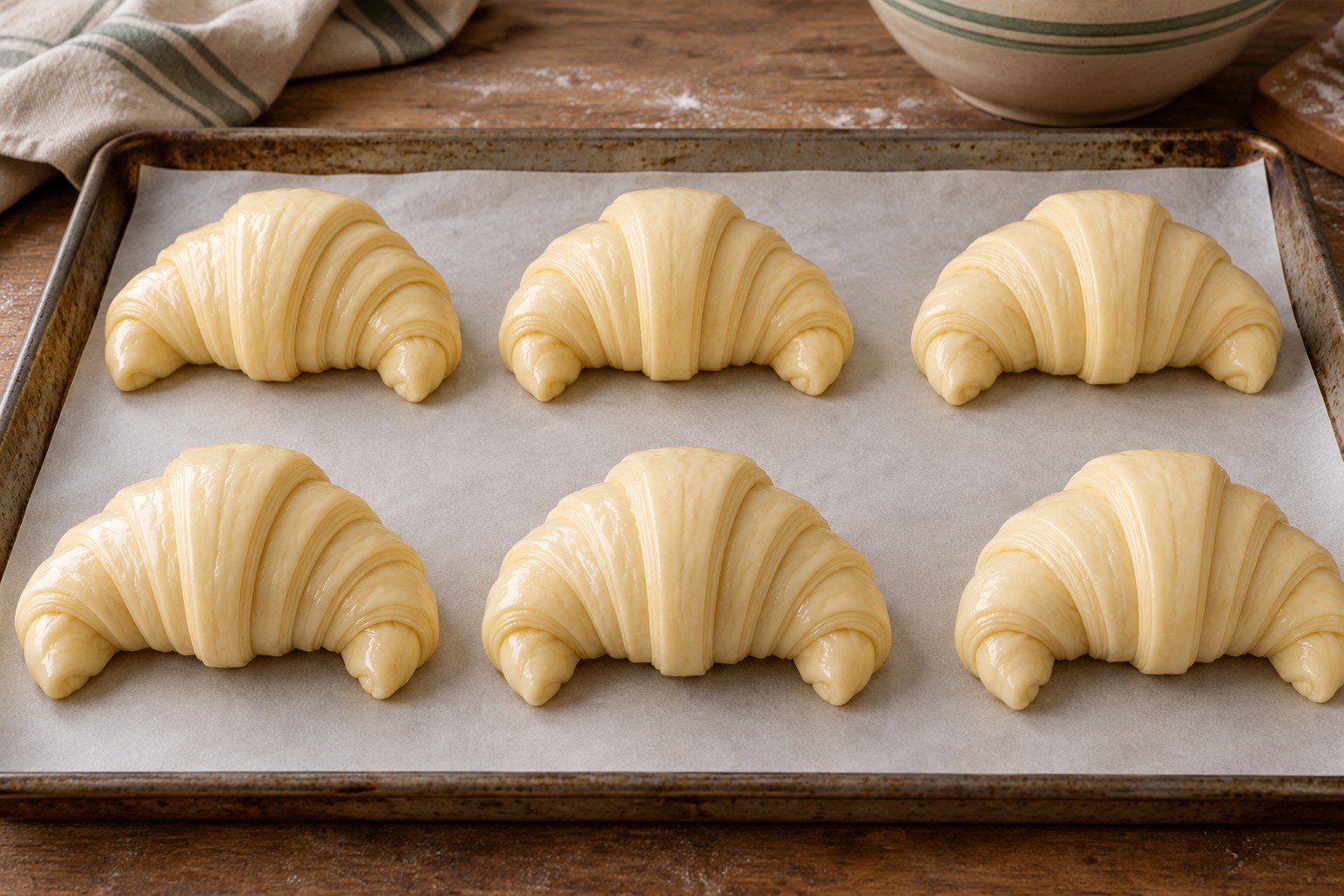
Starting at the short base, roll each triangle toward its tip without pulling so tightly that layers compress. Place tip underneath on two parchment-lined trays,6 per tray, leaving generous space. Cover loosely and proof at about 21–24°C / 70–75°F for 2–3 hours, until visibly expanded, light and slightly wobbly when the tray moves. Keep away from heaters and never use a hot proofing box that melts butter. The 150-minute allowance is a planning estimate, not a limit. - Egg-wash and bake
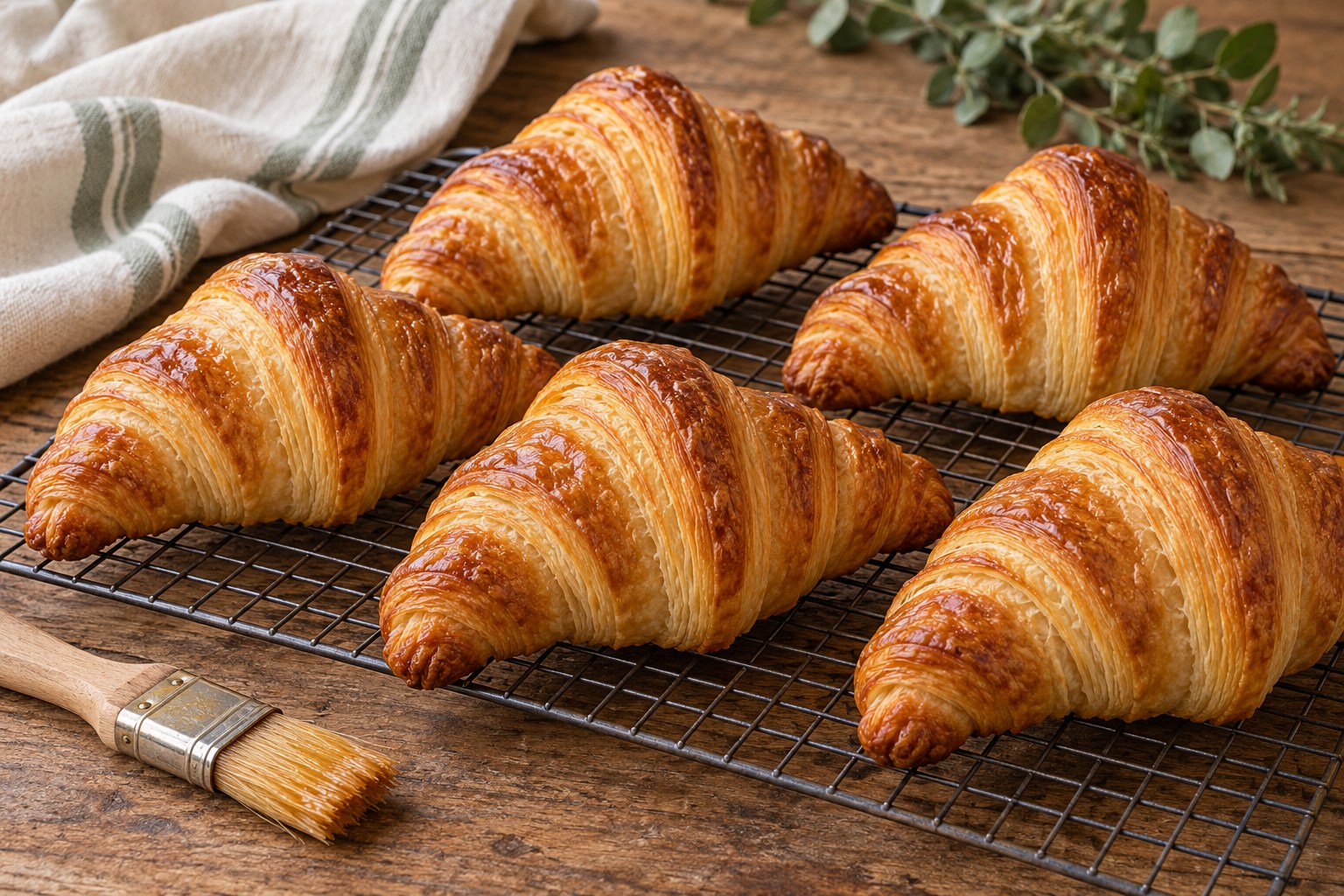
Preheat the oven to 200°C / 390°F conventional during proofing. Beat the separate egg with 10 ml / 2 tsp milk. Brush tops lightly, avoiding thick pools on cut edges, and discard unused wash. Bake for 10 minutes, lower to 190°C / 375°F and continue for 15–20 minutes until deeply golden with dry visible layers and a baked, not gummy, centre. If baking both trays together, leave air space and swap their positions carefully after about 15 minutes; ovens vary. The interior should reach about 93°C / 200°F. - Cool and portion
Move croissants to racks and cool for at least 30 minutes before serving. Do not squeeze hot croissants to judge their crumb. Serve one large croissant per portion for the stated nutrition. The sheet edges and egg wash are conservatively included in the estimate even if some flour or wash is discarded. No chocolate, almond filling or sugar glaze is included.
Cook’s notes
Keep butter cold yet pliable throughout lamination. Cracked butter creates uneven layers; melted butter becomes absorbed into the dough. Extra short cold pauses are preferable to forcing the rolling pin, but they extend the stated plan. This is a large 12-croissant batch, not twelve miniature pastries.
Storage & reheating
- Cool completely before wrapping. Keep unfilled baked brioche or croissants at cool room temperature in a clean airtight container for up to 2 days, or freeze cooled portions for up to 2 months. Thaw covered; refresh croissants briefly in the oven to restore some crispness. Do not store raw egg wash at room temperature for later use. Discard any mouldy bread or pastry.
Allergens
Wheat; Milk; Eggs
Approximate nutrition
Per serving: 365 kcal · Protein 6.7 g · Carbohydrates 37.4 g · Fat 21.2 g.
Approximate values per stated portion. Ingredient brands, edible yield and absorbed frying oil affect the result.