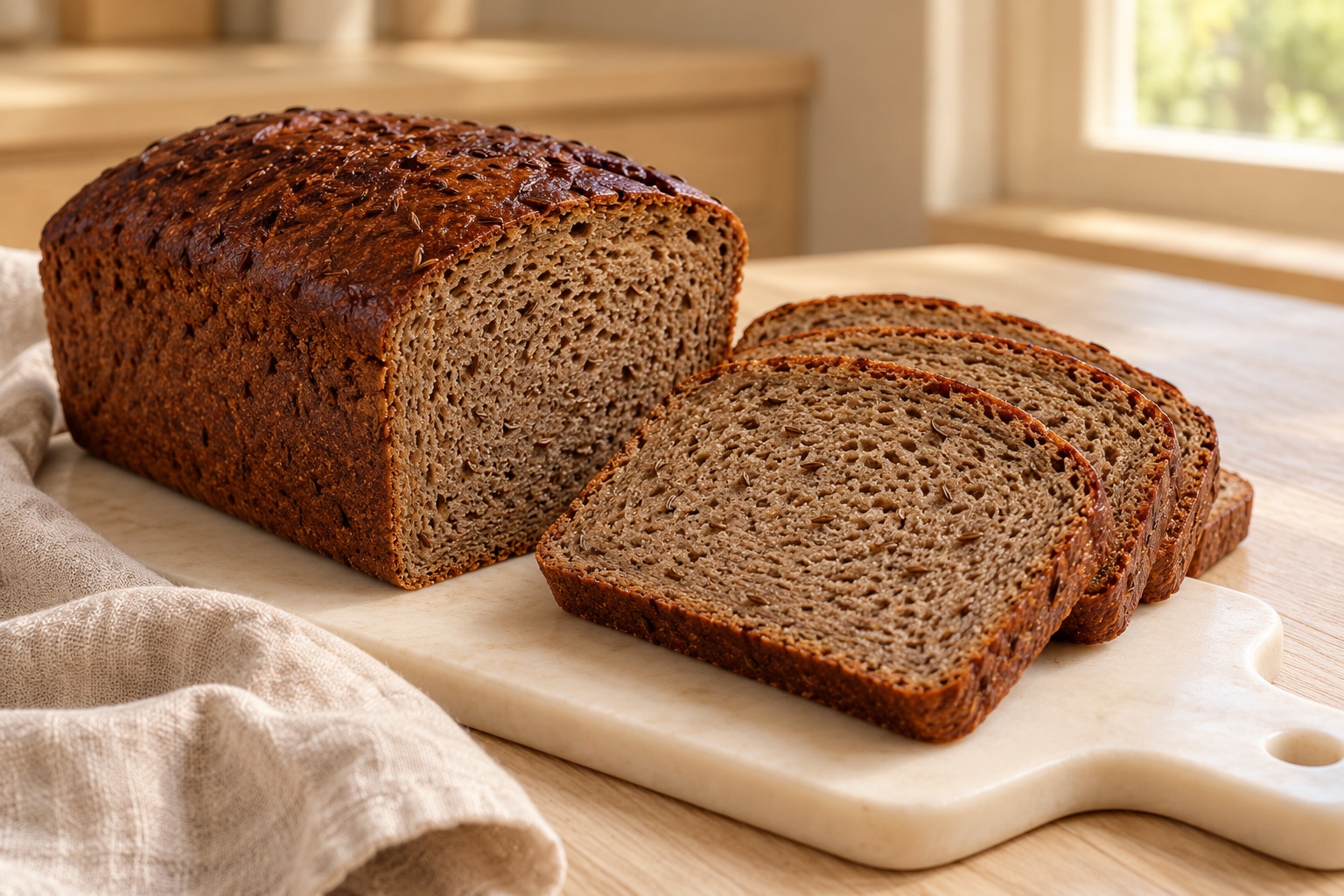
Each recipe provides measured ingredients, a detailed method, practical substitutions, storage guidance and approximate nutrition. A finished-dish illustration and four preparation images help explain the written steps. The recipes have not undergone independent kitchen testing.
Equipment
- Kitchen scale
- Large mixing bowl
- Flexible dough scraper
- Clear straight-sided container for bulk fermentation
- 23 × 13 cm / 9 × 5 in metal loaf tin, about 1.5 liter / 1.6 quart capacity
- Parchment paper
- Pastry brush
- Food thermometer
- Wire cooling rack
- Clean cloth
- Serrated bread knife
- Measuring jug
- Clean container cover
- Oven mitts and heatproof trivet
- Plain elastic band or removable height marker
Before you begin
Metric amounts are the reference; US quantities are rounded guides. A kitchen scale is especially useful for dough and baking. Use raw meat, fish and dry grains unless another state is specified. A trimmed or peeled weight is measured after that preparation. Whole birds and bone-in cuts have a different edible yield from prepared fillets or boneless meat. Dough water, braising liquid and water for boiling are different entries. Follow the instruction to retain, reserve or discard each one. Do not pour a full pot of boiling water into a sauce that needs only a small reserved amount. Salt volume changes with crystal size; spoon guides assume fine salt. Flour cup weights depend on filling method and flour type. Use the gram amount when consistency matters and keep spoons level.
Make it work
- Use medium rye flour as specified. Dark whole-rye flour absorbs water differently and requires a separate hydration adjustment. A wheat-fed starter changes the rye proportion and flavor. Dry yeast or baking powder cannot replace the starter directly in this high-rye formula.
Prep 25 min · Cook 65 min · Waiting 1860 min
Times are estimates. Thickness, pan size, oven behavior and batch size affect the result. Follow tenderness, texture and temperature instructions. Total time includes the stated waiting periods and subtracts only the overlap identified in the recipe.
Ingredients
- Bread dough — 7.05 oz / 200 g Ripe rye sourdough starter, 100% hydration — recently fed, visibly aerated and at or just before its peak; equal weights rye flour and water
- Bread dough — 8.82 oz / 250 g Medium rye flour
- Bread dough — 5.29 oz / 150 g Wheat bread flour
- Bread dough — 9.47 US fl oz / 280 ml Water — room temperature
- Bread dough — about 1⅔ tsp; varies by brand / 10 g Fine salt
- Bread dough — 0.21 oz / 6 g Caraway seeds
- Tin preparation — 1 tsp / 5 ml Refined sunflower oil — for greasing; all measured oil counted
Step-by-step method
- Check the starter
Use an established rye starter fed with equal weights flour and water. Measure 200 g when it is aerated, pleasantly sour and at or just before its peak. The time shown starts with this ripe starter; feeding or establishing one adds time. Unfed refrigerated discard will not give the same rise. Do not use starter with mold or pink or orange discoloration. - Mix the sticky dough
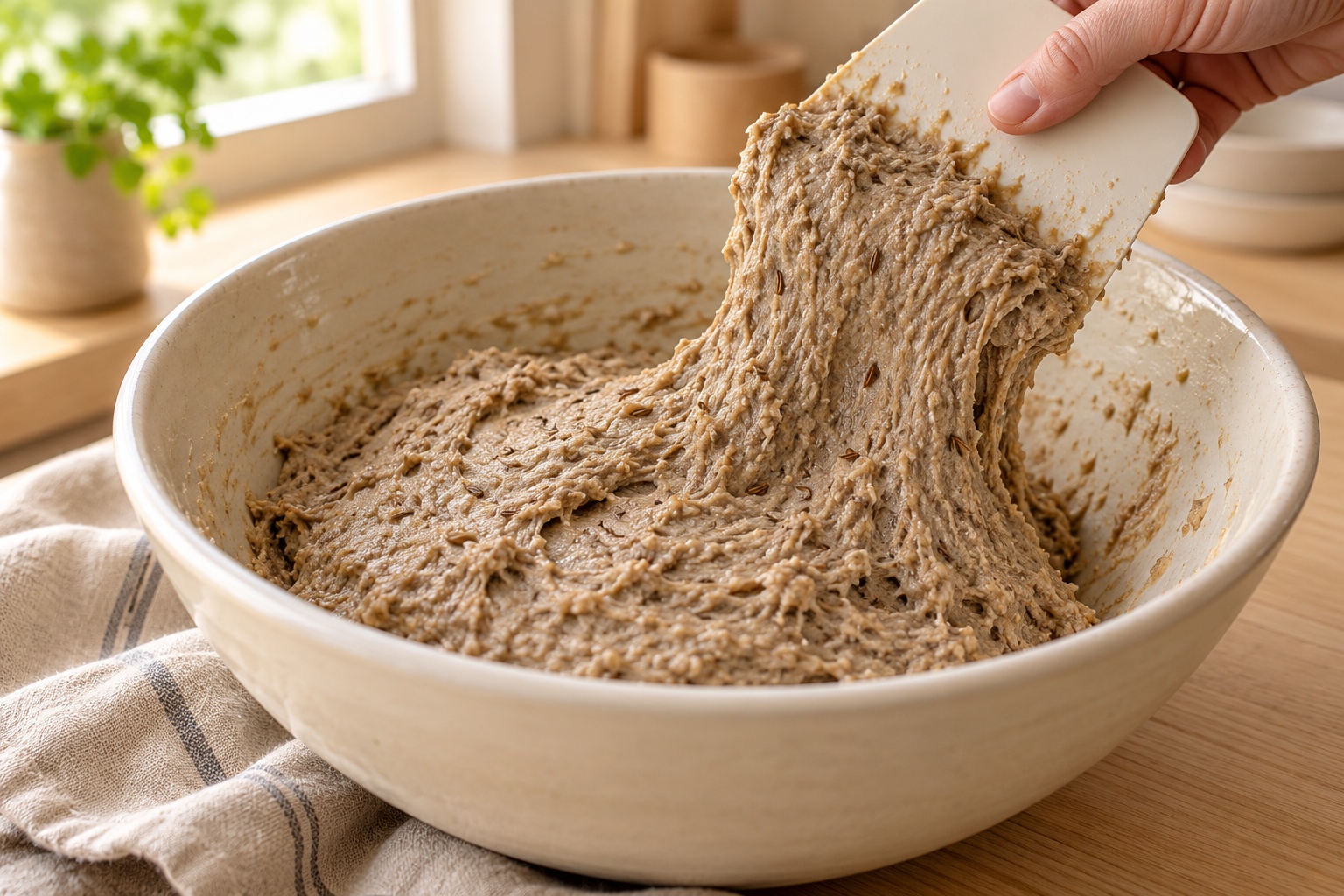
Mix starter and dough water in the bowl, then add both flours, dough salt and caraway. Mix firmly with the scraper for 5 minutes until uniform with no dry pockets. This high-rye dough is sticky and paste-like; do not add extra flour to make it behave like a wheat dough. Scrape into the clear container, level the top, mark the starting height and cover. - Ferment by appearance
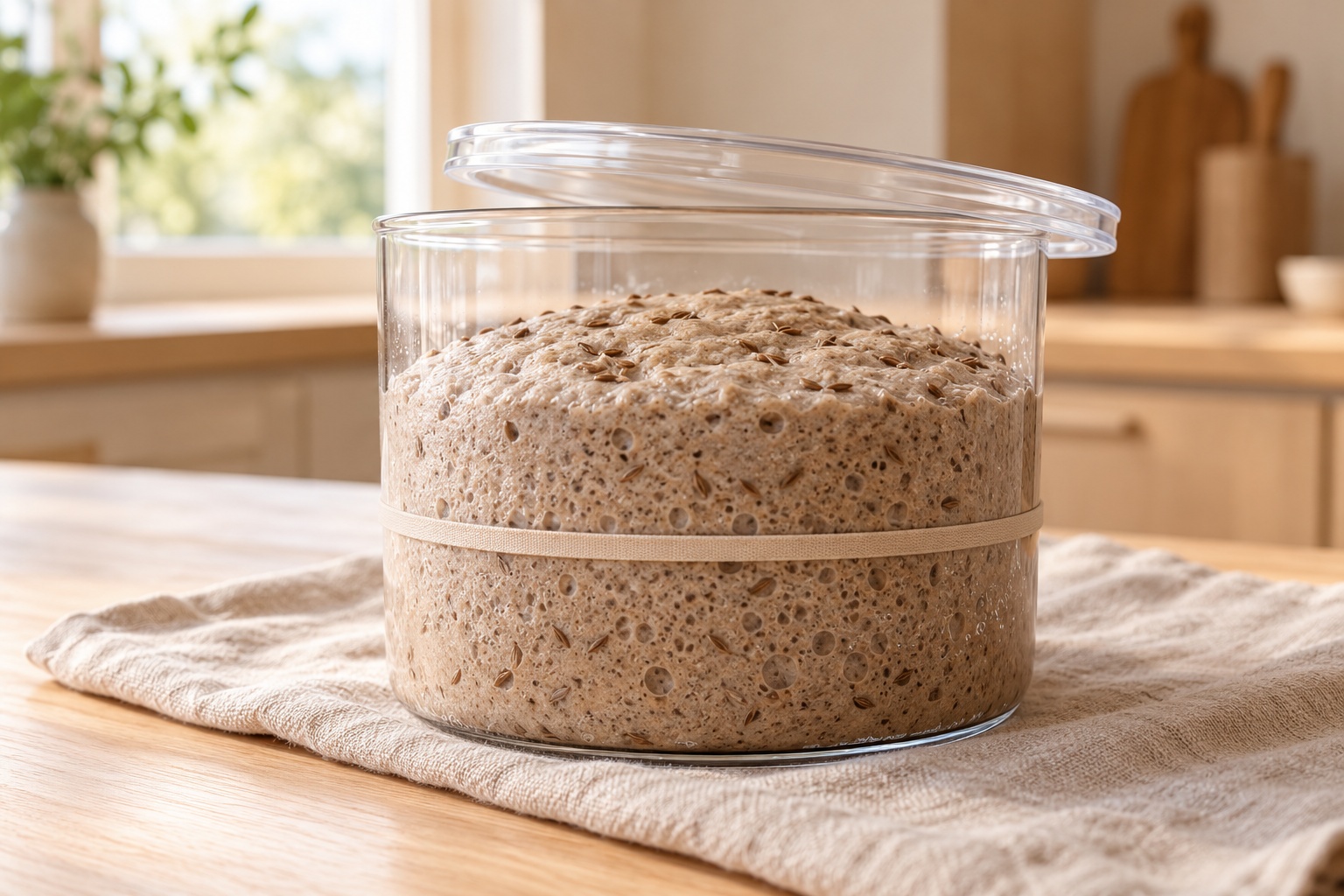
Keep at about 24–26°C / 75–79°F for roughly 3–4 hours, until visibly aerated and about one-third to one-half larger, with small bubbles along the sides. A cooler room or weaker starter takes longer. Follow these signs rather than ending fermentation merely because the clock has elapsed; do not wait for a dramatic doubling. - Fill the tin and proof
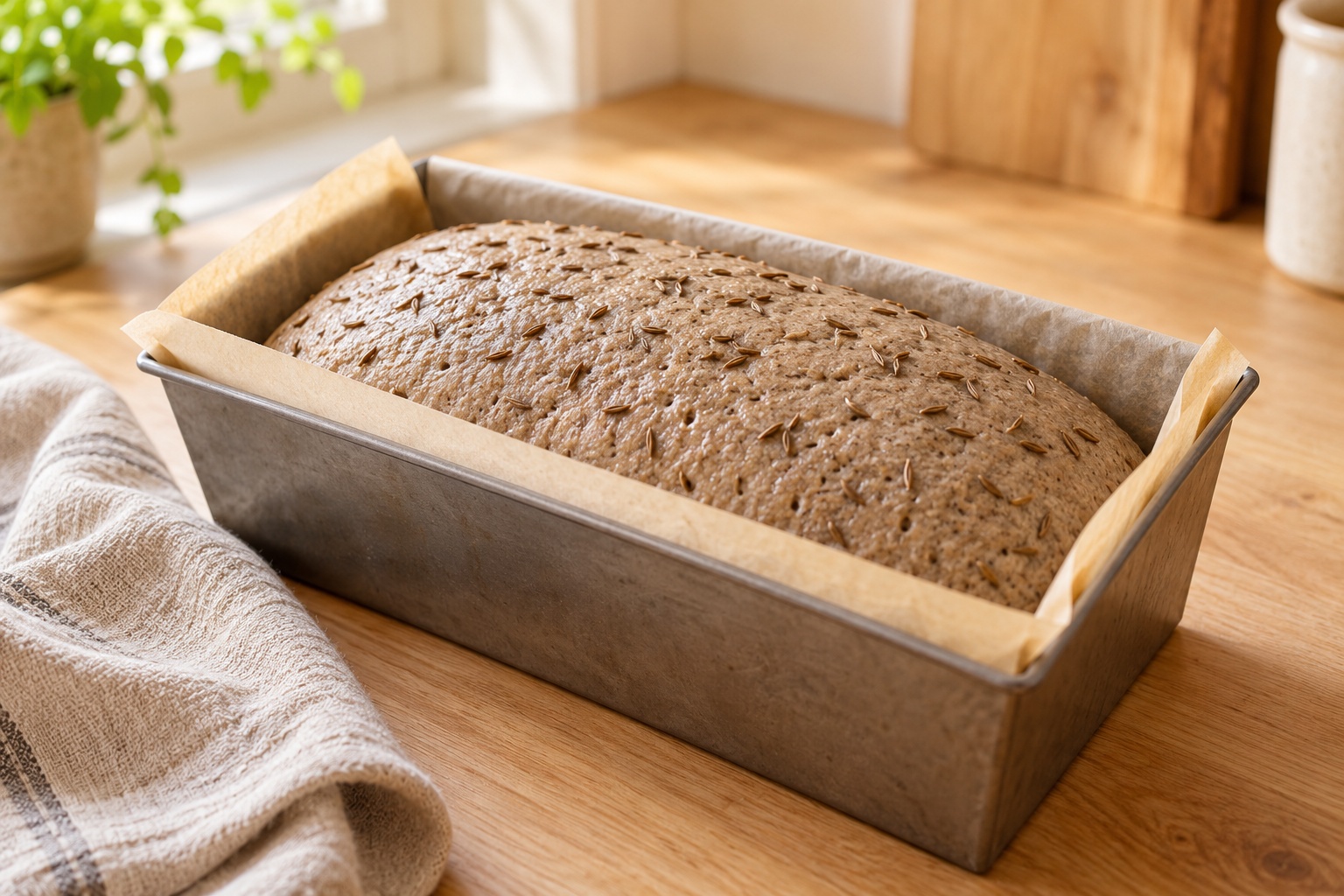
Brush the tin with measured oil and line its base and long sides with parchment, leaving enough overhang to lift the loaf. Scrape in the dough and smooth it evenly with a damp scraper. Cover without pressing on the surface. Proof at about 24–26°C / 75–79°F for roughly 1 1/2–3 hours, until the dough has risen about one-third to one-half above its starting level, with a slightly domed surface and a few small pinholes. Do not let it rise until it collapses or becomes deeply fissured. Preheat the oven during the last 20 minutes to 230°C / 445°F. - Bake and check
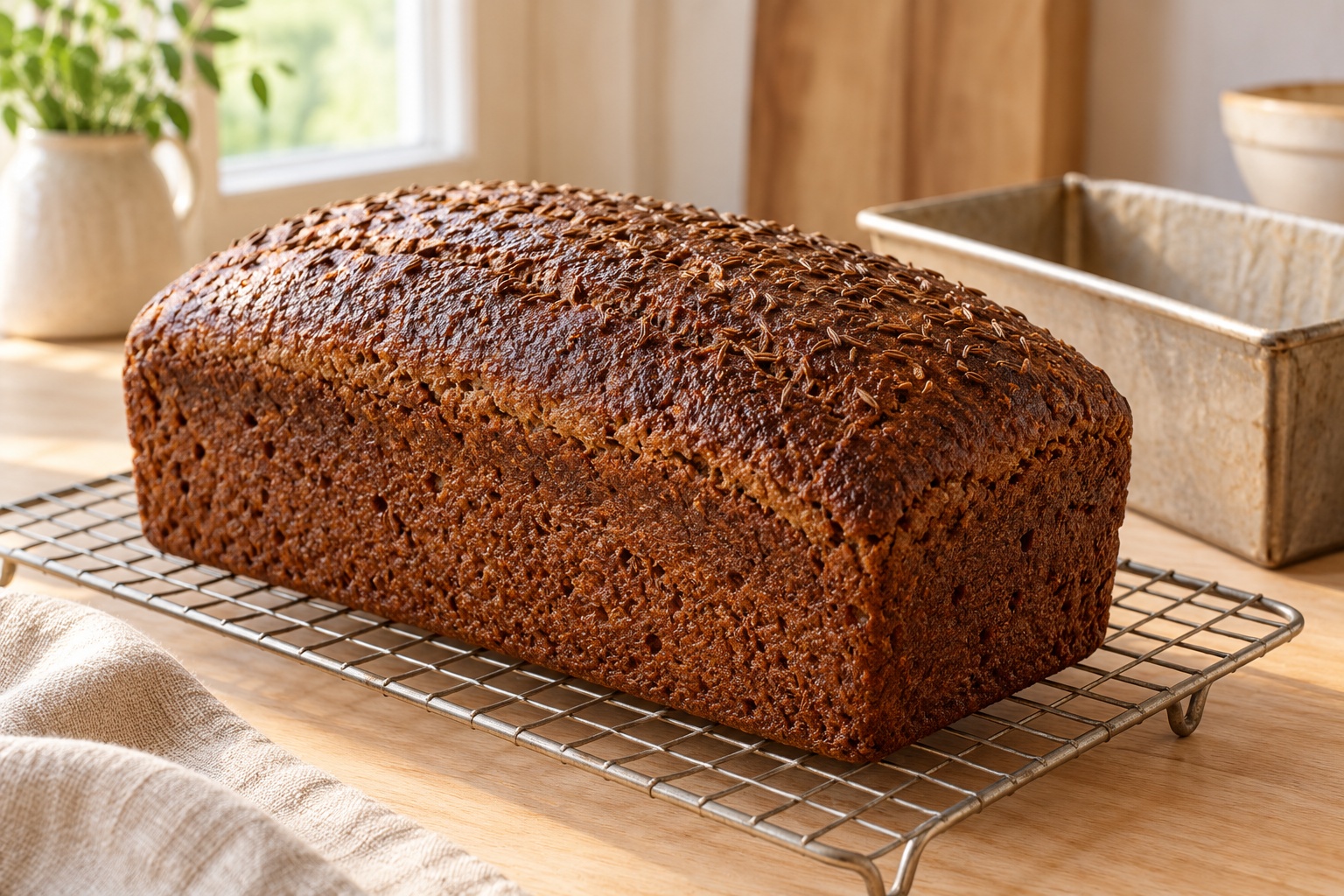
Uncover and bake on the middle rack for 15 minutes. Reduce heat to 200°C / 390°F and bake for another 45–50 minutes. The top should be deeply browned and firm, and the center should reach 96–98°C / 205–208°F. If necessary, continue in short intervals. Using oven mitts, put the tin on a heatproof trivet. Let stand for 5 minutes, then lift out carefully, remove parchment and place on the rack. - Cool before slicing
Cool completely on the rack, then wrap loosely in a clean cloth and leave at room temperature until 24 hours after baking. This long rest lets the rye crumb settle; cutting warm bread can make it appear gummy even when baked through. Slice with the serrated knife into 16 even slices. Fermentation timing varies, so the total of about 32 hours is a planning allowance rather than a fixed completion time.
Cook’s notes
Rye dough needs acidity, gentle handling and support more than prolonged wheat-style kneading. Use a vigorous ripe starter, watch both rises and allow the full cooling rest. The baked center temperature supports the doneness check but does not replace proper fermentation.
Storage & reheating
- After the 24-hour cooling rest, store loosely wrapped at a cool room temperature for up to 3 days. Discard the entire loaf if mold appears. Slice and freeze in an airtight bag for up to 2 months; toast from frozen or thaw covered at room temperature.
Allergens
Rye and wheat; gluten.
Approximate nutrition
Per serving: 114 kcal · Protein 4 g · Carbohydrates 23 g · Fat 1 g.
Approximate per serving. Values vary with ingredients, oil retained and portion size.